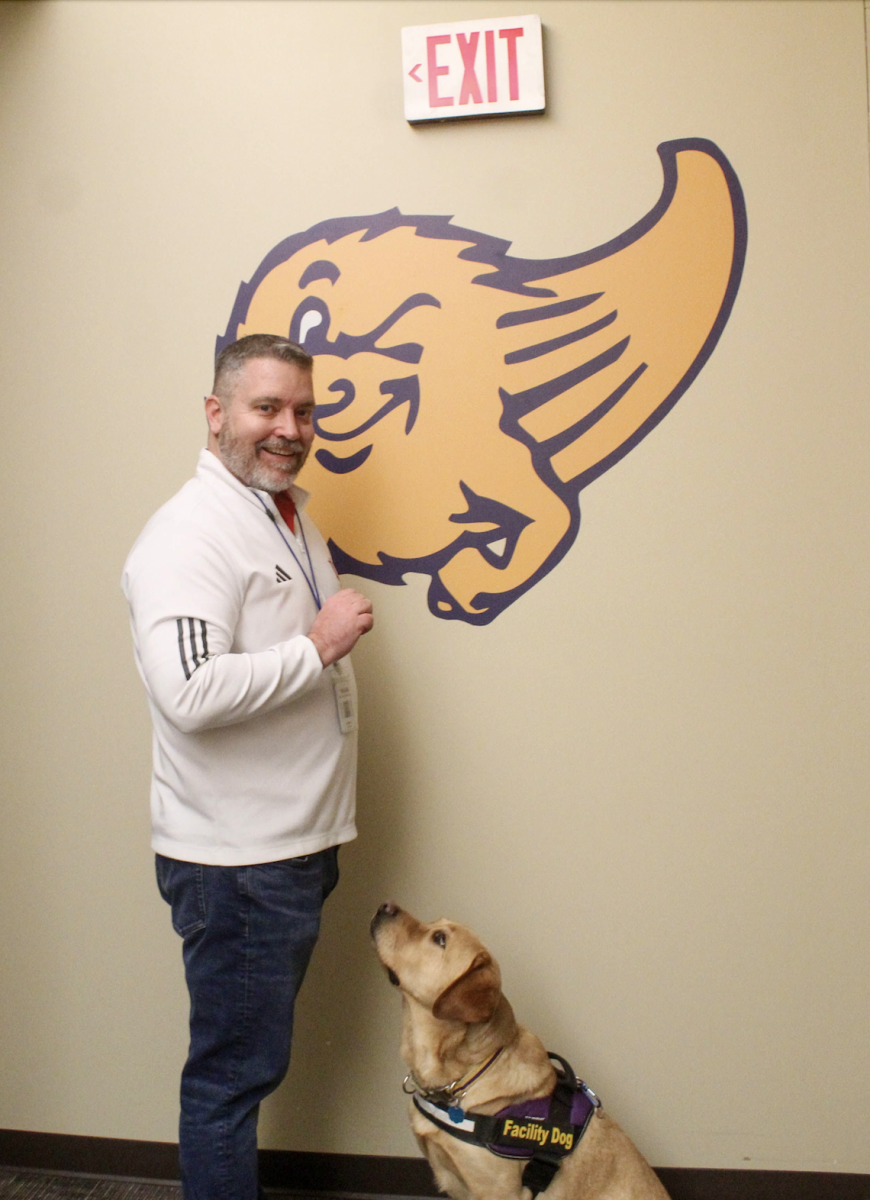
Facility dogs, from the Canines for a Change administration, have impacted many individuals throughout the Grand Ledge area in a healthy way. At Grand Ledge High School (GLHS), there are two service dogs: Gravy and Arlo. While Gravy has been at the high school since 2021, Arlo, who just recently became a service dog at GLHS, has become a new addition to our school’s community. Mr. Blake Wegenke, an assistant principal and Arlo’s trainer at the high school, talks about his enthusiasm for being able to work with Arlo.
“It’s a lot of fun to have a dog, to be able to share the dog with people, and see the excitement and joy, and just the connections that they have,” Wegenke said.
Arlo is willing to share joy to anyone, and he enjoys making people happy. He looks forward to helping students at the high school, while also making a positive impact on the public.
“He looks forward to it, and he enjoys the attention. He enjoys the pets; he enjoys the connection that he has, especially with the students and the faculty. He’ll spend as much time and hang out with anybody, you know? He has a six sense of knowing people. He knows when somebody’s looking for attention or to hang out. He’s a learner, I call him. A lot of times, he’ll just lean against somebody, it’s just who he is,” Wegenke said.
Even though it might seem easy, being a service dog can be exhausting, and the dogs have to go through a lot of training. Before one’s dog is able to get through training, there’s a requirement for a trainer. For instance, Wegenke is Arlo’s trainer, but before Arlo was officially taken in his hands, he expected the process to be temporary.
“A couple of years ago, Mrs. Capra came up to me and said, ‘Hey, just for a couple weeks, Canines for a Change needs somebody to watch Arlo, and then he’s gonna go somewhere,’ so we thought it was gonna be two weeks. Then it just kept on and built up over more and more time. So, yeah, that was pretty much it. But if we could have 100 labs, I’d have 100 labs. Like, we just, we love dogs,” Wegenke said.
When getting selected to be a service dog, the puppies have to go through a process to make sure they qualify. Canines for a Change needs to know whether they work well with people, aren’t too hyper, and can stay calm in any situation. Instead of getting certified only once, the dog has to go every year to make sure they’re still worthy of showing service. Wegenke talks a bit about how the whole process goes.
“So every year he has to get certified. You get certified at Canines for a Change, and that’s a lot of, like, sit, heal, distractions. Like, he has to walk, buy food, not eat, or sit for a while. I stay a minute, and then I have to call him, you know, things like that. And then they also have to pass in the school building,” Wegenke said.
Before Arlo was assigned to stay at the high school, he was designated to go to another building. While touring another Michigan school, Wegenke states that Arlo was less comfortable and shy, so the organization decided Arlo wouldn’t attend that school. After touring GLHS, the team stated he felt more comfortable and happier, so Arlo became the second service dog alongside Gravy.
“He was actually training to go to another building, and it didn’t work out. It wasn’t because of him; it was more of the adults. It wasn’t like they were bad people or anything. It was just the culture of that building, and they just weren’t comfortable with him. Some people from Canines for a Change were in the hallways here, for whatever reasons, and they would see him interacting, and they would say, “ Is he always like this”? And we’re like, “Yeah, he is,” and they’re like, “We didn’t see that in the other building, he seems much more happier and comfortable,” Wegenke said.
As Wegenke said, one of the reasons why Arlo felt comfortable at GLHS was the environment around the building, and with the help of Mrs. Maria Capra and Gravy, Wegenke states it wouldn’t be the same without them.
“I would give the kudos to Mrs. Capra and Gravy; they really set that culture. Mrs. Capra helped me out on a lot of this, cause she has the experience, with training labs for facility dogs, and service dogs. She’s so kind, she really helped me out with what they were looking for and the special techniques,” Wegenke said.
Even though training with a dog does seem fun, it can also be really exhausting. Trainers must be able to train the dog a few minutes every day, or the dog could risk losing its certification. Trainers also have to take care of the dog outside of school, which could interfere with work and other activities. Wegenke says he enjoy’s the training, but it’s also a lot of effort.
“So Arlo’s with me during the day, then he’s worked with me at night, and I absolutely love the training, but it’s also very much like a business, and he has to be on point. He has to learn, he has to pass tests. Sometimes he gets burned out from hanging out with me, so then he goes with my son or my wife. That’s probably the biggest challenge, but he’s a lot of fun to be with,” Wegenke said.
Training can be tiring not only for trainers, but also for the dogs. Wegenke describes when he plays with Arlo, he doesn’t normally get drained, but when he has to train, he gets burned out really quickly. When Wegenke takes Arlo and his other dogs on walks for three miles, they’re undisturbed, but when it comes to training, they get really worn out.
“Before it got colder, I always took my dogs for a walk, and I’d walk them for 3 miles, because it’s nice outside. But if I play a game of hide and seek, or if I teach them something, it will tire them out,” Wegenke said.
Overall, schools should utilize Canines for a Change because it’s impactful for a school’s environment and has been shown to make students and staff members more content.
“I really believe in the canine for a change in what they do, for the schools, and for the people. They’re awesome people who work there, and a lot of them are educators. You see what they do with the students, and so I’m a really strong advocate. I believe in the mission for Canines for a Change, and think that’s one of the most important service aspects. I think that’s one of the most important aspects of it,” Wegenke said.